4 Shortening Settlements Cycle
4.1 Goal
The Shortening Settlements See Relevant Rules or Procedures Cycle (SSC) project aims to reduce the settlement cycle to 9 business days following the end of the billing cycle and new revision 20 business days following the end of the billing period Energy Rules Terms.
This change reduced the prudential collateral AEMO Australian Energy Market Operator holds to covered accrued liabilities (unpaid settlement amounts) in the NEM. Lowering the capital requirements lowers the barriers to market entry for smaller retailers and provides increased investment in service innovation and more competition.
For more information, see Shortening the Settlement Cycle HLIA.
4.2 SSC changes
The SSC rule has three major components:
- Metering and settlement processes supporting the new, shorter settlement cycle.
- Credit limit procedures and supporting process to reflect the shorter settlement cycle.
- Transition metering, settlement and prudential processes from the current settlement cycle to the shorter settlement cycle.
4.2.1 Shorter settlement cycle
In the image:
- The current settlement calendar shows the preliminary and final statements posted on business days 5 and 18 respectively following billing week X. Final settlement occurs on business day 20.
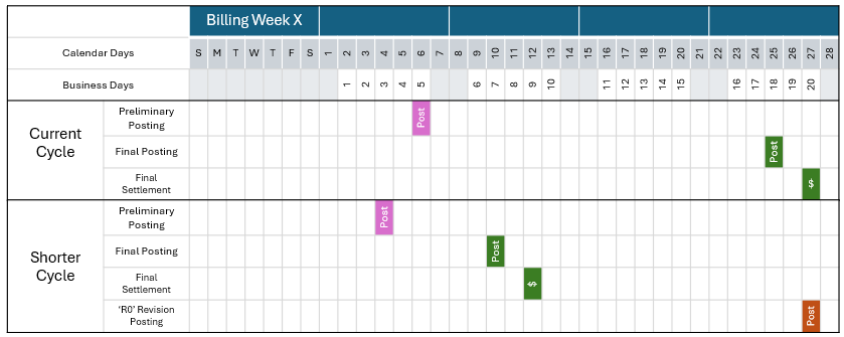
- The shorter settlement calendar includes an earlier preliminary statement posting on business day 3 and the final posting forward to business day 7 with settlement at business day 9. The R0 revision is posted on business day 20 with the R0 adjustment amount included in a final statement posted not less 10 than 8 business days after R0 posting, meaning, the final statement posted on business day 32 and settled on business day 34.
These changes involve an update to the metering, settlements and clearing calendars and a plan to transition from the current to the shorter settlement cycle.
4.2.2 Credit limit changes
This change reduces the timeline between a billing week and its financial settlement resulting in a reduced outstandings period. The outstandings period and the reaction period define the timeframe during which a participant’s liabilities may accrue and form the basis for establishing credit support requirements. A reduced outstandings limit indicates a lower the credit support and working capital requirements for participants.
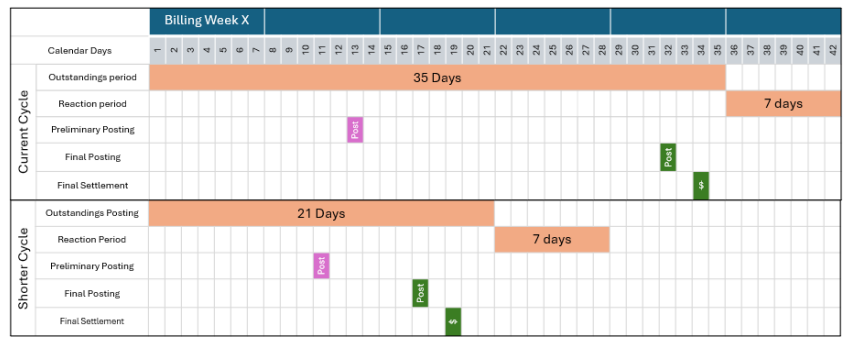
The image above illustrates:
- The relationship of the current settlement cycle to the 35 day outstandings period and the reaction period. The outstandings period represents the accrual of liabilities during normal operation. The reaction period is the time to remove a defaulting participant from the market.
- The shorter settlement calendar, highlighting the shortened outstandings period. The reaction period, which is a function of the default and suspension process, remains unchanged.
These changes involve an update to the Credit Limit Procedures (CLP) and a plan to transition to new credit support requirements.
4.2.3 Transition to shorter settlements cycle
AEMO transitions from the current to the shorter settlement cycle between August and October 2026. The transition plan ensures:
- Final statements and settlement are maintained in billing week order
- Transitional and new calendars are well understood
- Timing for new credit support requirements is clear
The following image is an example transition calendar from the current settlement cycle to a shortened settlement cycle. It includes the posting of preliminary, final and revision statements, the settlement of final statements and the metering data calendar that aligns with the preliminary and final settlement statement runs.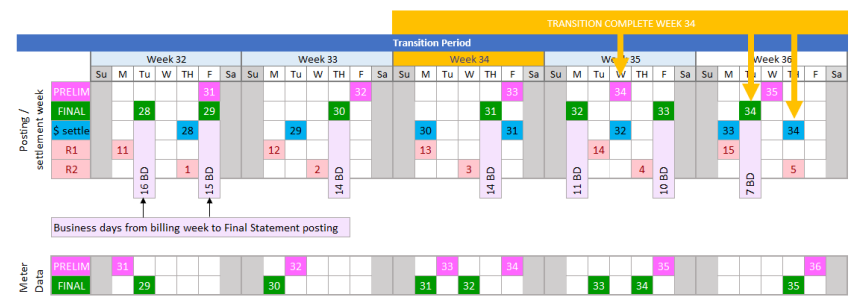
The transition period involves updating metering and settlement calendars and close collaboration with metering data providers (MDPs) and market participants to ensure a high-level of preparedness. AEMO facilitates prudential collateral return as soon as practical as the time period between billing week and settlement is reduced.
4.3 High-level changes
|
Function |
Description |
Reference |
|---|---|---|
|
Settlements |
|
|
|
Billing |
|
|
|
Prudentials |
|
|
|
Reporting and invoicing |
|
|
|
EMMS Data Model v5.7 |
|
|
|
Markets Portal |
|
|
|
APIs |
Detailed specifications and context for new and updated Prudential APIs |