4 Basic Power Quality Data
Basic Power Quality Data (BPQD) consists of voltage, current, and phase angle. From 1 July 2026, The National Electricity Amendment Rule 2024 No. 20, mandates the delivery of this data from smart meters (except Type 4A and Type 8B meters). BPQD is delivered by Metering Coordinators (MCs) or MDPs on behalf of the MC Meter Coordinator; The Role Code used in MSATS for an MC is RP. to Local Network Service Providers (LNSPs) using AEMO Australian Energy Market Operator’s Industry Data Exchange See Relevant Rules or Procedures (IDX), a data exchange hub for all markets.
4.1 Delivery mechanism
MCs deliver BPQD to Local Network Service Providers LNSPs using the Fire and Forget API Application Programming Interface; a set of clearly defined methods of communication between various software components. Channel on the IDX platform. This asynchronous data delivery mechanism does not require formal acknowledgements from the receiving party.
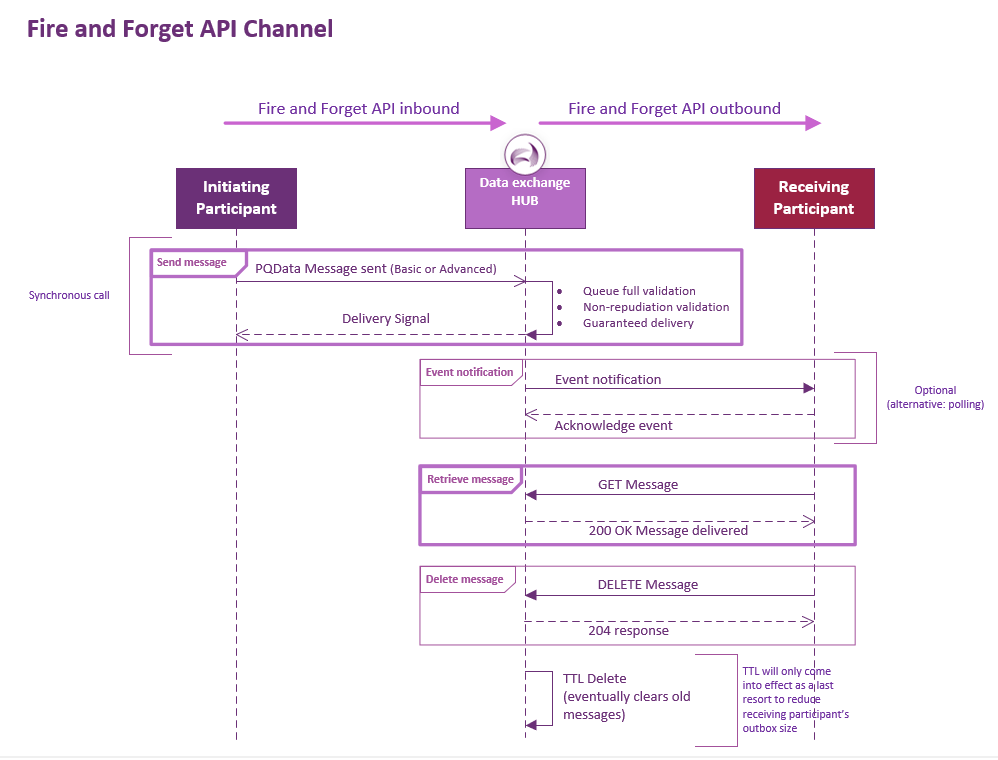
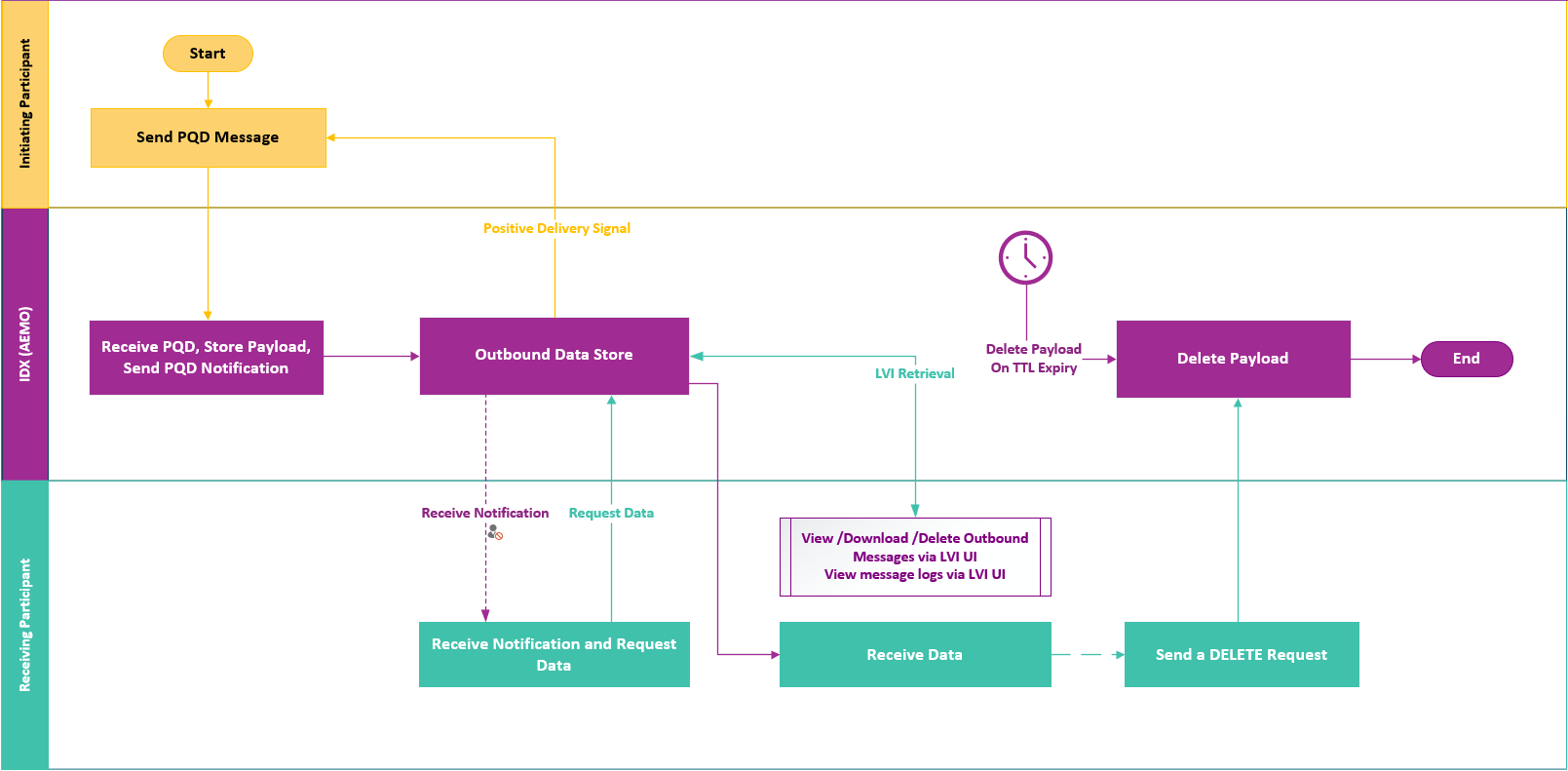
The process flow is described below:
|
Process |
Description |
Interface |
Role |
|---|---|---|---|
|
1 |
The Metering Coordinator (MC) or their delegate (for example, Metering Data Provider) submits a BPQD payload according to the PQD schema using the POST /bpqd API endpoint. IDX only returns an HTTP 200 OK response. No hub MACK is issued |
PQD API |
MC MDP |
|
2 |
Upon successful submission, IDX places the BPQD message into the recipient LNSP’s queue. The message remains in the queue for up to 10 calendar days, unless deleted earlier by the LNSP. |
Transaction log web interface or API |
|
|
3 |
IDX sends an WebSocket event notification to the LNSP, indicating a new message is available. |
Event subscription Event Notification API call to establish a connection for event notifications |
LNSP |
|
4 |
The LNSP uses the GET /bpqd API endpoint to retrieve metadata for all queued messages. To retrieve the full payload, GET /bpqd/{messageContextId} API endpoint is used. For troubleshooting purposes, messages can be downloaded from the IDX interface in the Markets Portal. |
PQD API Transaction Log web interface |
LNSP |
|
5 |
Message deletion: After successful retrieval, the LNSP sends a DELETE /bpqd/{messageContextId} API request to remove the message from IDX outbound queue. They can also delete the message in the IDX interface in the Markets Portal. If the message is not deleted, IDX automatically removes it after the TTL (Time to Live) expiry period of 10 calendar days. |
PQD API Transaction Log web interface |
LNSP |
4.2 High-level changes
|
Function |
Description |
Reference |
|---|---|---|
|
PQD API |
API for submitting and retrieving basic power quality data in the NEM |
|
|
IDX WebSocket |
Websocket for receiving BPQD event notifications and flow control events |
|
|
IDX APIs |
APIs to manage message flows, discover and inspect available business functions, view message and transaction history, and retrieve archived outbound payloads |
TBC |
|
Markets Portal |
New Markets Portal interfaces for LNSPs to assist troubleshooting PQD transactions, Participant accreditation and controls |
4.3 BPQD lifecycle
Basic Power Quality Data (BPQD) is delivered on Industry Data Exchange (IDX) as a Business As defined in the NERL. Function Resource. Each Business Function Resource on the IDX platform has its own configured Time to Live (TTL) and archive retention settings.
4.3.1 Time to Live (TTL)
Each BPQD message delivered to a receiving participant’s outbound queue is assigned a Time to Live (TTL). The TTL defines how long the message is available in the outbound queue if it is not deleted by the receiving participant.
For BPQD, the TTL is 10 calendar days from the time the message is successfully submitted to IDX. If the receiving participant does not delete the message within this period, IDX automatically removes the message from the outbound queue. Any message removed from the outbound queue is available in the archive, up-to the archive retention period.
4.3.2 Participant‑initiated message deletion
Receiving participants (for example, LNSPs) are expected to delete BPQD messages after successful retrieval. Messages are deleted by using either the:
- Power Quality Data API - DELETE /bpqd/{messageContextId} operation.
-
IDX Transaction Log interface in the Markets Portal Web applications for registered participants only. Requires access to MarketNet..
Deleting a message removes it from the outbound queue before the TTL expiry is reached.
4.3.3 Archive retention and expiry
Archive retention is defined per Business Function Resource. After message delivery, BPQD payloads are retained in the IDX archive for 30 calendar days. Once the retention period has elapsed, the payload is deleted from the archive.
4.3.4 BPQD configuration details
You can retrieve BPQD configuration details by querying the Business Function Information API. It includes the archive retention settings, TTL, schema versioning, and schema transition windows. For details, see the Business Function Information OpenAPI Specification.
4.4Flow Control
IDX automatically applies a stopped event for BPQD when the number of pending messages for the recipient (LNSP) exceeds the configured high‑watermark threshold. This occurs when messages are not deleted in a timely manner by the LNSP.
When a stopped event occurs:
-
IDX stops accepting new BPQD submissions for the affected LNSP.
-
Any new POST /bpqd API request for the LNSP is rejected with an HTTP 503 (Service Unavailable) response.
If an initiating participant (MC or MDP Meter Data Provider. An organisation which installs, commissions, gathers, and verifies data remotely from meters in the National Electricity Market (NEM).) is subscribed to WebSocket notifications, IDX sends a Flow Control Stopped event notification to the MC or MDP for the affected LNSP. Upon receiving the notification, they must suspend further BPQD submissions to the LNSP.
Alternatively, participants can retrieve the flow control status by:
-
querying the Flow Control API get / businessFunctions endpoint.
Copy{
"data": {
"businessFunctions": [
{
"businessFunctionId": "pqd",
"ackStatus": null,
"ackCount": null,
"ackBreachedTimestamp": null,
"messageStatus": "high",
"messageCount": 210,
"messageBreachedTimestamp": "2026-10-30T12:00:00.000+00:00"
}
]
}
}
-
viewing the Flow Control web interface.

Participants can view message and acknowledgement statuses only at the business function level. A subsequent release will enable Energy Rules Terms participants to view outbound status at the business function resource level through the Hub Queue web interface.
Initiating participants must not implement continuous or automatic retry logic while a flow control stopped event is active.
When the LNSP deletes sufficient messages to remove a stopped event, IDX sends a Service Running event notification to subscribed participants. MCs or MDPs can then resume BPQD submissions to the LNSP.