Release Information
MSUG Summary
The August 2026 Meeting Summary is released.
Data Model 5.8
The Electricity Data Model 5.8 version 1.02 is released.
NEM B2M and B2B Archived Message Payloads
Audience
NEM Retail MSATS and B2B systems B2M Business-to-Market and B2B Business-to-Business. Generic term used to refer to defined business-to-business interactions between participants; excludes interactions between a participant and market systems such as MSATS. Registered Participants Energy Rules Terms.
Participant impact
AEMO Australian Energy Market Operator is proposing to reduce the archive retention period for NEM Retail B2M and B2B archived message payloads from 13 months to 6 months.
This proposed change applies to:
-
All B2M and B2B transaction groups.
-
Archived payloads accessed through FTP participant file folders, API Archive, MSATS web portal, and B2B browser.
We are seeking concerns from participants who may not attend industry forums.
Please provide any concerns about the proposed change to nemreform@aemo.com.au by 24 July 2026.
Background and rationale
The current archive retention period is 13 months. Due to increasing archive volumes and associated storage and operational impacts, we are proposing to reduce the retention period to 6 months.
We sought feedback in industry forums regarding the current 13-month archive period and if it remains operationally necessary for participants. The feedback to move to a shorter retention period of 6 months emerged as the strongest supported position.
Implementation
February 2027 (TBC To be confirmed)
We intend to implement the revised 6-month archive retention period in February 2027. The exact implementation date is still to be decided.
Further information
For more details, download the slide pack.
|
AEMO Archive Message Payload Retention.pdf |

Contact
ICF017 ADWAN Reporting Changes - December 2026
Audience
Participants performing the Metering Data Provider Energy Rules Terms(MDP Meter Data Provider. An organisation which installs, commissions, gathers, and verifies data remotely from meters in the National Electricity Market (NEM).) or Local Network Service Provider Energy Rules Terms(LNSP) role.
Participant impact
AEMO is introducing new RM29 Active Data With Non-Active NMI Energy Rules Terms(ADWNAN) reporting queries. ADWNAN reporting is split by participant role and data quality type:
- ADWNAN_INTERVAL_ACT - A report sent to LNSPs listing non-active NMIs with active datastreams containing interval data. This replaces the ADWAN_INTERVAL report from 6 December 2026.
- ADWNAN_INTERVAL_SUBS - A report provided to MDPs listing non-active NMIs with active datastreams containing substituted interval data.
Background and rationale
The RM29 ADWNAN_INTERVAL report does not distinguish between actual and substituted interval data, resulting in additional investigation by LNSPs. ICF017 introduces separate reporting streams to direct actual data exceptions to LNSPs and substituted data exceptions to MDPs.
Implementation
- Pre-production AEMO’s test system available to participants: 17 November 2026
- Production AEMO’s live system: 6 December 2026
Contact
API URL Changes - September 2026
The API URL Changes - September 2026 are in pre-production. We request GAS, NEM and WEM participants to test the new 4 API Changes.
Key actions for participants:
-
Update integrations to use the new pre-production URLs.
-
Execute end-to-end connectivity and functional testing.
-
Validate :
-
Authentications and certificates.
-
API requests and response behaviours.
-
Existing business processes.
The release dates are:
- Pre-production: 17 June 2026
- Production: 23 September 2026
- Decommissioning legacy URLs: 1 December 2026
-
To raise any pre-production issues, contact apiuplift@aemo.com.au.
Industry Data Exchange
AEMO MSATS browser feedback
AEMO is seeking your help to improve the Participant B2B aseXML A standard for energy transactions in XML. A set of schemas and usage guidelines that define how data should be exchanged under FRC in the gas and electricity industries in Australia. Schema See aseXML Schema., B2B Transforms, and Protocols experience.
AEMO is improving the experience for managing Participant B2B aseXML Schema, B2B Transforms, and B2B Protocols in the new IDX Industry Data Exchange Web Application Subscription Management interface.
We invite you to complete a short survey. Your feedback helps us understand:
- Your overall satisfaction with the current process.
- How easy it is to use and understand the current interface.
- How we can improve the experience.
The survey is anonymous and closes on 31 August. Share this survey to anyone else who manages the B2B aseXML Schema, B2B Transforms, and B2B Protocols.
IDX knowledge library
Based on feedback for Industry Data Exchange See Relevant Rules or Procedures learning content in MSUG Market Systems User Group, we have published the IDX Knowledge Library in the Technical Specification Portal.
The following topics are now available:
- Basic Power Quality Data API
- IDX Release 1 - Web Applications and APIs Overview
- IDX Release 1 - Basic Power Quality Data (BPQD) API Demonstration
- AEMO Gateway Software Overview
AEMO gateway software
The AEMO Gateway Software production release is now available in the EMMS Energy Market Management System (formerly MMS); software, hardware, network and related processes. Production FTP File transfer protocol server.
The published components are:
- pdrBatcher Software responsible for transferring files to and from AEMO's participant file server to the participant's local Data Interchange folders. It can be installed in any environment supporting Java./AEMO Gateway Software - /Releases/pdrBatcher/Production/v8.0.2
- pdrMonitor - /Releases/pdrMonitor/Production/v1.4.2
- pdrLoader Software responsible for loading files to and from participant's local Data Interchange folders to the participant's DBMS. It can be installed in any environment supporting Java. - /Releases/pdrLoader/Production/v7.7.2
- Certificate Helper - /Releases/CertificateHelper/Production/v1.0.2
The suite of software supports multiple configurations including IDX/Power Quality Data, Data Interchange A set of cooperating applications used to replicate data between AEMO's energy market systems and a participant's DBMS conforming to the MMS Data Model. services, NEM Wholesale EMMS, Gas Bulletin Board (GBB), Declared Wholesale, Declared Wholesale Gas Market (DWGM Declared Wholesale Gas Market. A Victorian gas market that allows trading on injections and withdrawals from the Declared Transmission System (DTS).), Short Term Trading Market (STTM Short Term Trading Market. A wholesale market that facilitates short-term gas trading between gas shippers and users. STTM hubs operate in Adelaide, Brisbane and Sydney.), and Gas Supply Hub Gas Trading Exchange (GSH Gas Supply Hub. An exchange for the wholesale trading of natural gas.).
The updated Industry Data Exchange – AEMO Gateway Software – August 2026 technical specification is also available.
Release notes
Data Interchange processes
Data interchange improvements and implementation instructions for pdrBatcher, pdrLoader and pdrMonitor are available in the Technical Specification Portal.
Participants planning in-situ upgrades of existing installations should follow the recommended upgrade order. The latest versions of the pdrBatcher and pdrLoader applications are a prerequisite to upgrading to the latest version of pdrMonitor. Following this order ensures component compatibility during the upgrade process.
IDX/Power Quality Data
The following change notes are incremental upgrades to the existing AEMO Gateway Software v8.0.1 release.
Participants note the following enhancements for this release:
- Updates to log messages and configuration descriptions to correct grammar and clarity.
-
Removes properties file documentation for unused oauth_{name}_request_scope configuration property.
-
Adds threadId as an eventing variable and included it in the MessageContextId definition to reduce the risk of message collisions and IDX 409 response errors.
-
Hides the WebSockets checkbox on the packs selection page to prevent accidental selection, as this functionality is not yet available.
Participants note the following new features for this release:
- Adds a new pdrEncryptionKeyCycle.bat command line script. This script cycles the encryption key and updates all encrypted parameters in the properties configuration file with the updated key.
-
Adds a new API to report any messages stored in the Error folder, allowing them to be surfaced in pdrMonitor.
-
Add support for IAM role for AWS S3 access.
Participants note the following resolved defects for this release:
- Corrects shell escaping of special characters (& < > = , ; ^) in the pdrPasswordEncrypt script.
-
Aligns the interpretation of IDX 404 response codes to detect messages that have already been consumed. This issue arises from a change to the core IDX platform response format when AEMO GW is configured with multiple parallel processing threads. AEMO GW now correctly interprets these response codes and surfaces only genuine 404 errors in the application log.
-
Ensures any IDX 429 response code (Too Many requests) causes the application to exit the current polling cycle and the thread to sleep for the Fail Wait interval period.
-
Corrects a defect that can cause filename contention when writing Performance files to the Performance folder. This issue occurs only under high throughput conditions with multiple threads, enabled API web services, and no Monitor consuming performance data.
-
Corrects a defect so the flow-control state appears immediately in Monitor at startup. This issue has no functional impact on transaction flow control in the batcher.
-
Corrects a defect, so the Windows service is also uninstalled when AEMO GW is removed using the uninstaller.
-
Corrects a defect in IDX GUI installer where previously selected business functions, such as the Windows Service, appear on the Options packs screen.
-
Adds a RENAME translator to the IDX configuration, so Monitor reports the correct filename. This change applies only when Monitor is installed and connected.
-
Prevents sensitive information associated with API requests and responses from appearing in DEBUG mode. Sensitive information may still appear in TRACE mode, as described in the pdr_log4j.xml log configuration file.
-
Enhances the pdrBatcherTransformTest script to escape special parameters passed as arguments that may be required as part of a transform definition, e.g. ‘|’.
Participants using the GUI installer for an in-situ upgrade should note that the upgrade applies standard configuration settings only. It is recommended if you use custom configurations to install the new version in a separate directory. Run the new and legacy versions side by side, so you review and reapply your custom settings. Once the new installation is operating as expected, you can remove the legacy version. Rollback is to stop the new service and restart the previous service.
The following resources are available to participants:
- Industry Data Exchange – AEMO Gateway Software – Technical Specification – August 2026
- Industry Data Exchange – Industry Data Exchange Platform – Technical Specification – August 2026
- AEMO Gateway Software configurations walkthrough
- Market Interface Technology Enhancements Working Group (MITEWG) - AEMO Gateway demonstration
Participants who need assistance to configure and install AEMO Gateway Software can refer to:
- AEMO Gateway Software implementation instructions
- pdrBatcher, pdrLoader, pdrMonitor - DI Help documentation
Data Model 5.7
The Electricity Data Model 5.7 v3.00 is released.
-
Data Model 5.7 is now in production
Settlements package update
We have updated the primary key columns SERVICE and CONTRACTID to VARCHAR2(20) in the following tables:
-
Modified table: SET_NMAS_RECOVERY
-
Modified table: SET_NMAS_RECOVERY_RBF
Participants must upgrade to the Data Model The definition of the interface to participants of data published by AEMO for gas or electricity. A database conforming to the Data Model can contain a local copy of all current participant-specific data recorded in the main database. The Data Model includes database tables, indexes, and primary keys. v5.7 to receive the data type changes and avoid data load failures after the transition period. For more information, see 3.3 Settlements package update
NEMWeb
- NEMWeb changes go live 18 May 2026.
- HTTP to HTTPs Tuesday 7 April 2026
- pdrBatcher patch update, Monday 23 February. The patch is accessible through the following channels:
Participants can access the patch through the Participant File Server.
Non-participants can download the patch from Data Interchange Help. The patch is available in the Data Interchange bundle.
For instructions to apply the patch, See Implementation Instructions.
- Post-production: 3-phased report framework to identify and discontinue:
- Superseded The participant can receive files compliant to the The participant can receive files compliant to the superseded aseXML version, and needs to change over their receiving system before the next aseXML version release. reports replaced by another report
- Reports not maintained in line with the rules or where the original need for the report doesn’t exist
Release dates
- Pre-production: No pre-production
- Production: Monday 18 May 2026
For more information, see NEMWeb - May 2026.
aseXML Schemas
Schema changes and release dates
Data Model 5.6
Discontinued reports
In Electricity Data Model v5.6, the following tables are moved into HISTORICAL package:
- BILLING_DIRECTION_RECONCILIATN
- BILLINGCPDATA
- BILLINGGENDATA
- RESERVE
- SET_RUN_PARAMETER
- SETCPDATA
- SETGENDATA
- SETSMALLGENDATA
- SETCPDATAREGION
- SETGENDATAREGION
Participant interfaces changes
There was an error in the report version of the CSV Report A data report that loads into a data model table. Identified by its type, subtype, and version. For example: BILLING,BILLINGASPAYMENTS,2 Type in Participant Interfaces Changes. The latest Data Model v5.6 publish Energy Rules Terms corrects this.
|
Package
|
Data model table
|
File ID
|
CSV report type |
|
|---|---|---|---|---|
|
Old |
New |
|||
|
DISPATCH |
DISPATCHLOAD |
DISPATCHIS |
DISPATCH,UNIT_SOLUTION,5 |
DISPATCH,UNIT_SOLUTION,6 |
|
|
DISPATCHLOAD |
NEXT_DAY_DISPATCH |
DISPATCH,UNIT_SOLUTION,5 |
DISPATCH,UNIT_SOLUTION,6 |
|
P5MIN |
P5MIN_UNITSOLUTION |
P5MIN |
P5MIN,UNITSOLUTION,6 |
P5MIN,UNITSOLUTION,7 |
|
PRE-DISPATCH |
PREDISPATCHLOAD |
NEXT_DAY_PREDISPATCH_D |
PREDISPATCH,UNIT_SOLUTION,4 |
PREDISPATCH,UNIT_SOLUTION,5 |
|
|
PREDISPATCHLOAD |
PREDISPATCHIS |
PREDISPATCH,UNIT_SOLUTION,4 |
PREDISPATCH,UNIT_SOLUTION,5 |
Production issue
There is a known issue in Production where the PARTICIPANT_REGISTRATION data does not load for PARTICIPANTCATEGORY table. The pdrLoader fails after 10 attempts. AEMO will publish an updated category to fix the issue and notify participants.
NEM Report Updates
On 14 August, AEMO sent a notice about the NEM reports for PDPASA DUIDAVAILABILITY and PDPASA REGIONSOLUTION tables were missing data for Interval Period over which interval energy data is recorded by the metering installation that corresponds to a TI or submultiples of a TI._DateTimes between 00:00 and 04:00 inclusive on the first trading day Energy Rules Terms, for PDPASA runs between 00:00 and 04:00 inclusive.
These updates are now available in production from 10:30 PD Pre-dispatch run onwards.
Updating Short Term PASA Rule - NEM Production system changes
AEMO has deployed all core changes to the ST PASA Short Term Projected Assessment of System Adequacy. A daily load forecast that shows expected demand two to seven days ahead of time. Procedure and Recall Period The advance notice (in hours) that a scheduled resource will require to achieve the PASA Availability MW for this trading interval. initiative in production.
Participants should ensure the bid PASA Availability PASA Availability For a scheduled generating unit, scheduled bidirectional unit, scheduled load or scheduled network service in a given period, its available physical plant capability (taking ambient weather conditions into account) and any additional physical plant capability that can be made available during that period within a given recall period in accordance with the reliability standard implementation guidelines and its associated bid Recall Period The 288 periods from 4:30 am to 4:00 am. reflect the ST PASA Projected Assessment of System Adequacy. except executable files e.g., .DLLs, .LIBs and .EXEs with the user mentioned. See National Energy Rules Procedures from 31 July 2025. The Bidding system changes to add the new Recall Period were implemented in Production on 1 July 2025.
As part of the ST PASA Procedures consultation, the PD PASA and ST PASA LRC reports are discontinued, as these not used for operational decision Energy Rules Terms making.
Participants using the Data Interchange should subscribe to the latest file IDs using Data Subscription A web application in the Markets Portal used to subscribe to Data Interchange files and to obtain the latest MMS Data Model. These files are typically csv files containing public data and participant’s private data. AEMO recommends participant use of the Data Interchange suite of products, supplied by AEMO, to automate receiving and storage of the files to their systems. AEMO provides working sample software for FTP access (Participant Batcher) to MarketNet and working sample software for Data Interchange. in the Markets Portal Web applications for registered participants only. Requires access to MarketNet..
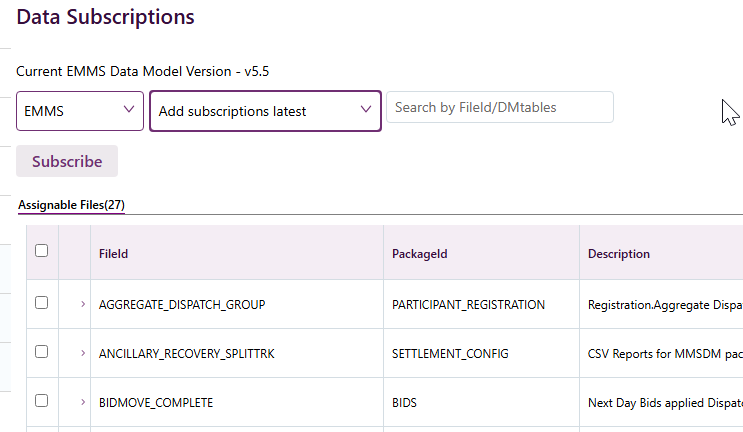
NEM report changes
- Adds new PDPASA_DUIDAVAILABILITY and STPASA Short-term Projected Assessment of System Adequacy. 30 minute resolution, seven days ahead. A daily load forecast showing expected demand two to seven days ahead of time._DUIDAVAILABILITY report files:
- For every PDPASA and STPASA run, publish Max Avail, PASA Avail and Recall Period for each half-hour for all scheduled resources
- Updates following reports in existing Next Day Bid See Relevant Rules or Procedures files, to include the new Recall Period:
- BIDMOVE_BIDPEROFFER_D_COMPLETE (file: PUBLIC_BIDMOVE_COMPLETE)
- NEXTDAY_BIDOFFERPERIOD_ENERGY_SPARSE (file: PUBLIC_NEXT_DAY_OFFER_ENERGY_SPARSE)
- NEXTDAY_MNSP_BIDOFFERPERIOD (file: NEXT_DAY_OFFER_ENERGY_SPARSE)
- NEXTDAY_BIDPEROFFER_FCAS_SPARSE (file: PUBLIC_NEXT_DAY_OFFER_FCAS_SPARSE)
- Updates following reports in the existing PDPASA and STPASA files:
- PDPASA_REGIONSOLUTION
- Updated calculation of AGGREGATEPASAAVAILABILITY, to reflect PASA Availability with a Recall Period ≤ 24 hours
- Removed OUTAGE_LRC run type
- PDPASA_INTERCONNECTORSOLN
- Removed OUTAGE_LRC run type
- PDPASA_CONSTRAINTSOLUTION
- Removed OUTAGE_LRC run type
- STPASA_REGIONSOLUTION
- Updated calculation of AGGREGATEPASAAVAILABILITY, to reflect PASA Availability with a Recall Period ≤ 24 hours
- Removed RELIABILITY_LRC, OUTAGE_LRC run types
- STPASA_INTERCONNECTORSOLN
- Removed RELIABILITY_LRC, OUTAGE_LRC run types
- STPASA_CONSTRAINTSOLUTION
- Removed RELIABILITY_LRC, OUTAGE_LRC run types
Sparse Data Filter Configuration Example
Sparse data filter configuration example included in Sparse Data Model.